
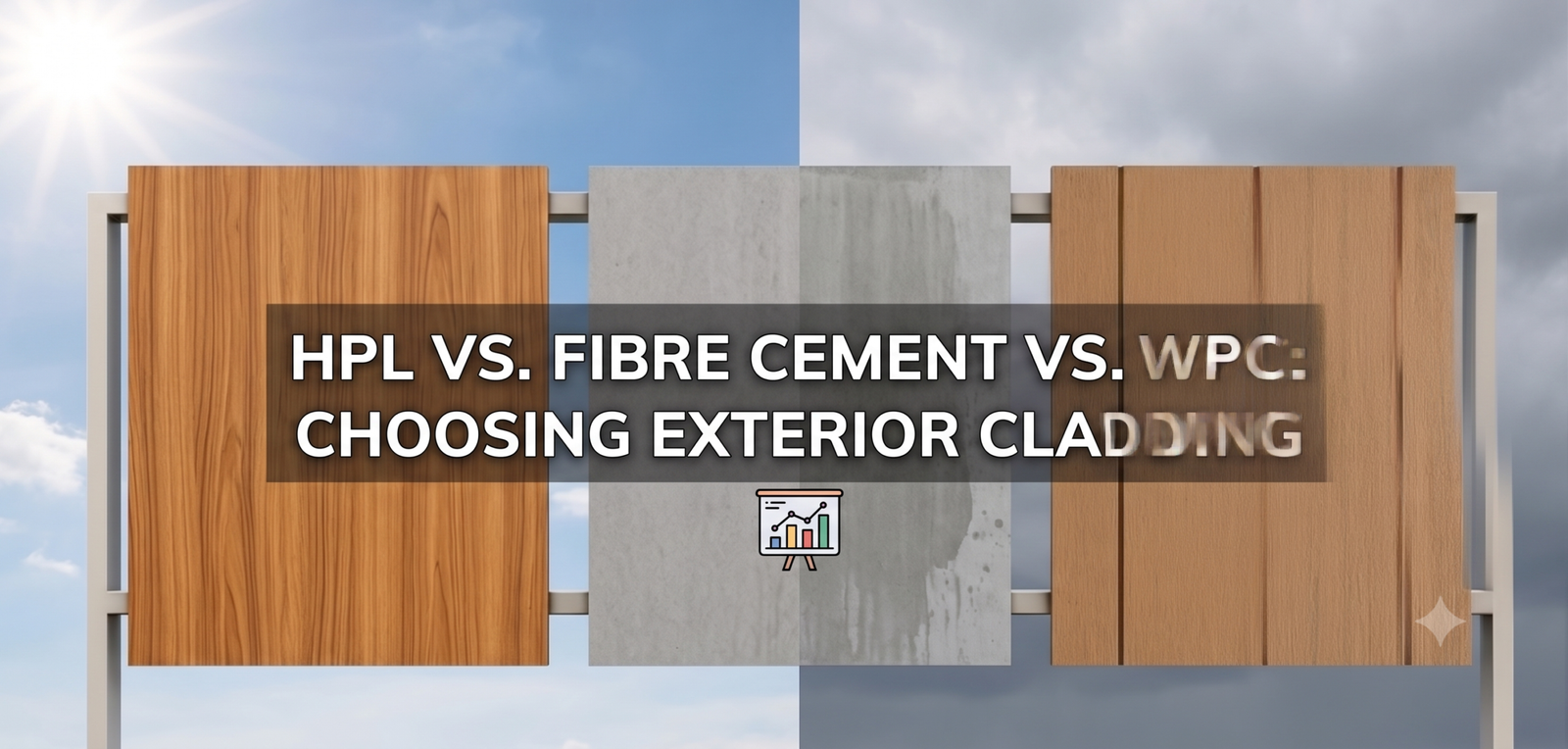
Quick answer: HPL offers the best combination of appearance, surface durability and colour stability but costs more. Fibre cement board is non-combustible and economical but usually needs painting and can absorb water. WPC is easy to install and rot-free but can sag and fade under strong sun. Choose by exposure, fire requirement and how long the building must look good.
Table of Contents
- The Four Contenders
- Head-to-Head Comparison
- Choosing by Priority
- Total Cost Perspective
- A Reasonable Mixed Strategy
- Frequently Asked Questions
The Four Contenders
High Pressure Laminate (HPL)
Kraft paper and thermosetting resin pressed into a solid dense panel with a decorative face and, in exterior grades, a UV-protective surface. Colour is part of the panel, not a coating on it.
Fibre cement board
Cement, cellulose fibre and additives formed into a board. Non-combustible, heavy, dimensionally stable, and typically supplied to be painted or with a factory coating.
WPC (wood plastic composite)
Wood flour blended with plastic and extruded into planks or panels. Immune to rot and termites, easy to cut, and available in wood-look profiles.
ACP (aluminium composite panel)
Two thin aluminium skins bonded to a polymer core, included here because it is the most common alternative quoted alongside the other three.
Head-to-Head Comparison
| Parameter | HPL | Fibre cement | WPC | ACP |
|---|---|---|---|---|
| Surface durability | Very high | Moderate, depends on coating | Moderate | Moderate |
| Colour stability outdoors | Very high (exterior grade) | Depends entirely on paint | Fades over time | Depends on coating grade |
| Water behaviour | Very low absorption | Absorbs if uncoated or cut | Very low absorption | Metal unaffected, edges vulnerable |
| Fire behaviour | Combustible; FR grades available | Non-combustible | Combustible | Depends on core |
| Dent and impact | Very good | Can crack on sharp impact | Can scratch and mark | Dents easily |
| Weight | Moderate | Heavy | Light to moderate | Light |
| Maintenance | Washing only | Repainting cycle | Washing, occasional replacement | Washing |
| Appearance range | Very wide – wood, stone, solids | Limited, mostly painted | Wood-look profiles | Solids and metallics |
| Cost | Higher | Low to moderate | Moderate | Low to moderate |
Choosing by Priority
- If appearance over twenty years is the priority – HPL, because the decor is pressed into the panel rather than painted onto it.
- If non-combustibility is mandatory – fibre cement board is inherently non-combustible; if you prefer HPL’s appearance, specify a tested FR grade and satisfy the fire consultant.
- If budget is the binding constraint – fibre cement or basic ACP, accepting the repaint or replacement cycle that follows.
- If you want a timber look without maintenance – HPL wood decors hold colour better than WPC in strong Indian sun, though WPC gives genuine profile depth.
- If the building is short-hold or temporary – ACP or WPC will do the job for the period concerned.
Total Cost Perspective
The cheapest panel is rarely the cheapest facade. Fibre cement’s coating is a recurring cost, WPC panels may need section replacement, and low-grade ACP coatings chalk within a few summers on a west elevation.
Run the comparison as installed cost plus twenty years of maintenance, including scaffolding for every intervention. The ranking often reverses once access costs are included, which is why long-hold owners – homeowners, hospitals, campuses, hotel groups – keep arriving at HPL.
A Reasonable Mixed Strategy
There is no rule that a building must use one material. A common and sensible approach in Indian projects:
- HPL on the primary elevation and all high-contact ground-level surfaces.
- Fibre cement or plaster and paint on rear and service elevations that are neither seen nor exposed.
- ACP where curved or folded geometry genuinely requires a formable panel.
- WPC for deck and pergola elements where a timber profile is wanted underfoot or overhead.
Key Takeaways
- HPL leads on surface durability and colour stability; fibre cement leads on non-combustibility.
- WPC is rot-free and easy to install but fades and can sag under strong sun.
- Fibre cement’s repaint cycle is a recurring cost that first-quote comparisons ignore.
- Compare installed cost plus twenty years of maintenance including access.
- Mixing materials by elevation is often the most rational strategy.
Frequently Asked Questions
Which is better, HPL or WPC cladding?
HPL generally holds colour better under strong Indian sun and offers a wider decor range including stone and concrete effects. WPC gives genuine profile depth and is light to install, but can fade and sag over long spans in heat.
Is fibre cement board better than HPL?
Fibre cement is inherently non-combustible, which is a genuine advantage where fire regulation is strict. HPL offers better surface durability and colour stability without a repainting cycle, and fire retardant grades are available.
Which cladding lasts the longest?
Well-installed exterior HPL is designed for around twenty to twenty-five years with washing only. Fibre cement can last as long structurally but its appearance depends on maintaining the coating.
Which cladding is cheapest?
On the first invoice, fibre cement and basic ACP are usually cheapest. Over twenty years including repainting, replacement and scaffolding access, the ranking frequently changes in favour of HPL.
Can different cladding materials be mixed on one building?
Yes, and it is often the most rational approach – HPL on primary and high-contact elevations, simpler materials on rear and service elevations, and formable panels where curved geometry demands them.
Related Reading on HPL Maker
Talk to HPL Maker
HPL Maker is an Indian manufacturer of exterior-grade high pressure laminate with an industry-first live camera warranty of up to 25 years. Share your drawings or elevation photos and our team will suggest the right shade, thickness and fixing system for your project.
- Call / WhatsApp: +91 89824 90236
- Email: marketing@hplmaker.com
- Factory & Head Office: 124-126, Vrindavan Palace, Nipania Main Road, Vijay Nagar, Indore – 452010, Madhya Pradesh, India